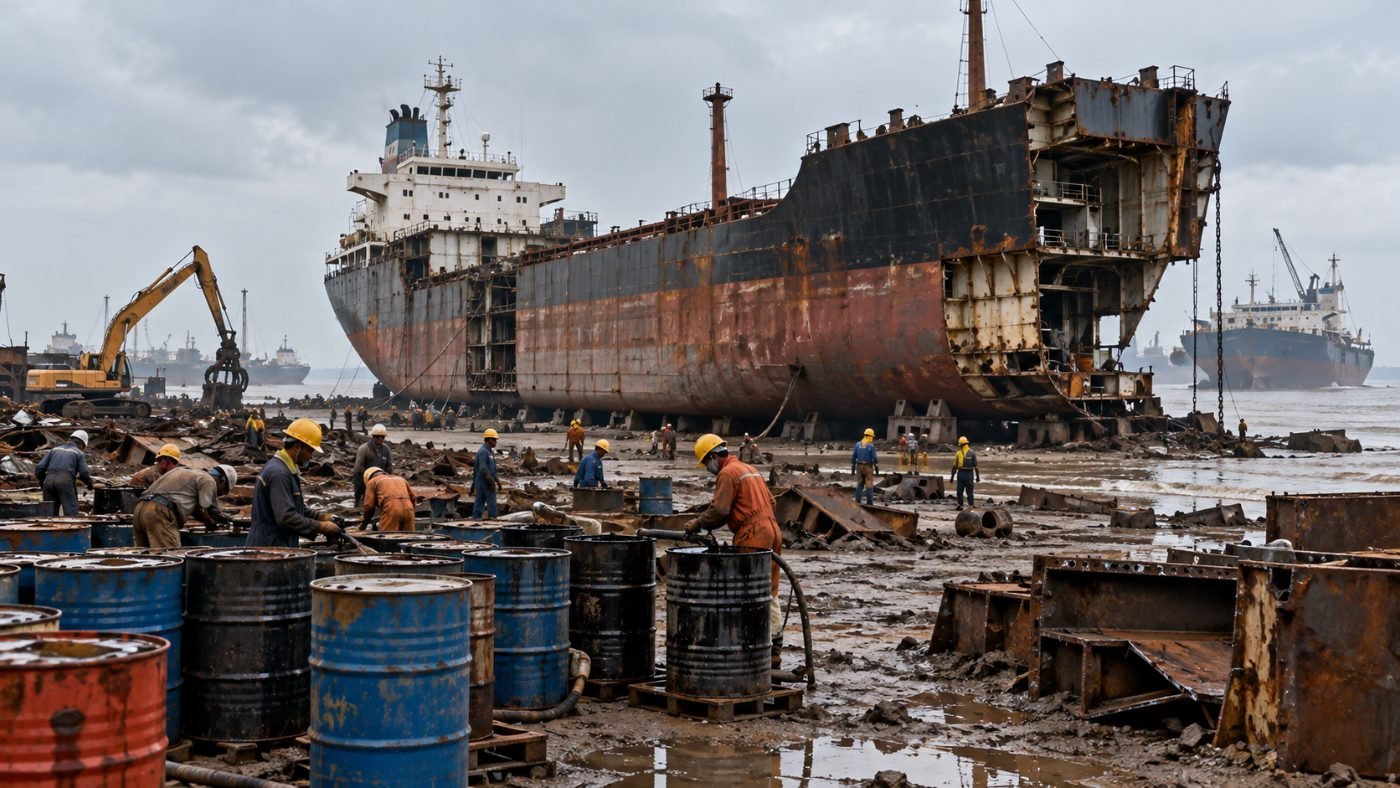
Alang-Sosiya in Gujarat is the world's largest ship-recycling cluster. Every vessel beached for recycling yields drained engine, hydraulic and gear oil plus bunker slops — a very large, concentrated used-oil source that must move under hazardous-waste manifest.
Marine oils vary from clean engine stocks to heavy bunker slops. We test each lot for water, salt and sludge before quoting — clean engine oil re-refines, heavy slop is co-processed.
Indicative of the kind of operation we collect from. Listing a company name here is an industry reference, not a claim of an existing contract.
Indicative and lot-dependent. Clean engine oil prices well; salty, watery or sludgy slops price lower. We test salt, water and sludge before we lift.
Direct contracts with recycling plots under the Gujarat Maritime Board (GMB) framework, with lifting aligned to the Ship Recycling (Hong Kong Convention / Recycling of Ships Act, 2019) hazardous-waste regime. Bulk tanker capability is essential.
Moderate water and salt are manageable and priced accordingly; heavy emulsification or sludge lowers yield. We test before quoting rather than after lifting.
Yes — heavier slop and sludge are routed to re-refining or lawful co-processing, separately from the cleaner engine oil.
Yes — movement is under Form-10 and the hazardous-waste regime that applies to ship recycling (Recycling of Ships Act, 2019 / HKC).
Yes — bulk tanker lifting is our preferred mode and suits the concentrated volumes at a recycling yard.
Yes — CPCB EPR recycler (BHA20250073R); Form-10 and recycling documentation provided.
Send us the oil type, approximate annual quantity and location. We will come back with a landed price and a lifting schedule — and if a stream falls outside our authorization, we will tell you that instead.
Get a quote on WhatsApp